

"Nagseni — full of scenic beauty and located east of Kishtwar town, surrounded by forests and fed by sacred springs — is a land where ancient Buddhist philosophy, living Naga traditions, and pristine Himalayan wilderness converge in extraordinary harmony. It is one of the most historically layered and naturally beautiful tehsils of District Kishtwar."
Tehsil Nagseni is one of the most richly layered administrative sub-divisions of District Kishtwar in the Union Territory of Jammu and Kashmir. Located approximately 30 kilometres north-east of Kishtwar town along the Kishtwar–Paddar Road, Nagseni is celebrated for its dense Himalayan forests, sacred mountain springs, ancient Buddhist heritage connections, and a deeply rooted Naga-worship tradition that continues among its people to this day.
Covering an area of approximately 697 square kilometres, Nagseni remains largely untouched by mass tourism — preserving its traditional lifestyle, ecological richness, and the quiet dignity of a land that has been home to remarkable historical and spiritual activity since at least the 2nd century BCE.
Historical Significance — The Nagasena Connection
The name "Nagseni" is believed to originate from the great Buddhist philosopher and monk Nagasena, who lived during the 2nd century BCE and is celebrated as one of the most brilliant minds of the ancient Buddhist world. Nagasena is famous for the Milinda Panha — a landmark Buddhist philosophical text that records a dialogue between the Indo-Greek king Menander I (known as Milinda) and the Buddhist monk Nagasena.
The Milinda Panha is a lively dialogue on Buddhist doctrine in which King Milinda — the Greek ruler of a large Indo-Greek empire in the late 2nd century BCE — poses questions and dilemmas that are answered by Nagasena, a senior monk. In their famous discussion, Nagasena presents the celebrated "simile of the chariot" to explain the Buddhist concept of the not-self — just as a chariot is not one singular independent thing but is composed of parts, in the same way, that which we call the "self" is not a singular independent entity but is likewise composed of parts.
In many books published on Kishtwar history, Nagasena is described as having been born in Kunja village of Galigad, Trigam Pargana of Kishtwar. The route from Kajangal (Kunja) passes through Kujagala to village Bhattan, which is identified as the Vattaniya Ashram of Milindo-Panho. Village Bhattan and its adjoining areas are said to have remained centres of vital religious and cultural activities of Buddhist scholars for centuries.
It is important to note that the identification of the name "Nagseni" with Nagasena remains a subject of scholarly discussion. The stronger historical and textual evidence supports Kajangala near Rajmahal in eastern India as Nagasena's probable birthplace, while the Kishtwar claim is more a regional tradition reflecting later cultural reverence rather than a directly verified historical fact. Nevertheless, the tradition is deeply embedded in the region's cultural identity and continues to draw scholarly interest and local pride alike.
▶ Milinda Panha — Key Facts
- What it is: A landmark Buddhist philosophical dialogue between Indo-Greek King Menander I (Milinda) and Buddhist monk Nagasena
- When composed: Believed written between 100 BCE and 200 CE, likely in northern India; possibly originally in Sanskrit
- Most famous teaching: The Chariot Simile — explaining the Buddhist concept of no-self (anatman)
- Canonical status: Canonical in Burmese Buddhism; included in the Khuddaka Nikaya; translated into Chinese during the Eastern Jin dynasty
- Outcome of the dialogue: Following his discussions with Nagasena, King Menander adopted the Buddhist faith "for as long as life shall last" and eventually handed over his kingdom to his son to retire from the world
- Kishtwar connection: Local tradition identifies Nagseni and Bhattan village as Nagasena's homeland; the Vattaniya Ashram of Milindo-Panho is associated with village Bhattan
Geographical Location & Administrative Profile
Nagseni lies in the rugged Himalayan terrain of the Chenab Valley, to the north-east of Kishtwar town. The tehsil is surrounded by thick forests and numerous seasonal streams, and its topography — deep valleys, mountain ridges, and forested slopes — has played a significant role in preserving both its traditional lifestyle and its extraordinary ecological richness.
The original Pargana of Nagseni consisted of the villages of Kwar Tenji, Bhagna, Chandna, Bhattan, Dumzi, Dajla, Chingnana, Galhar, Bhata, Piyas, Bhata Semna, Ajna, Chhichha, Sazar and Cheerji.
[gallery columns="4" link="file" ids="1756,1757,1758,1759"]Weather & Climate
Nagseni experiences a typical Himalayan temperate climate — cool and pleasant in summer, cold with snowfall at higher elevations in winter. The best time to visit for tourism and outdoor activities is April to October.
Tourist Places & Attractions in Tehsil Nagseni
The landscape of Nagseni remains largely untouched by mass tourism, making it one of the most peaceful and authentic destinations in Kishtwar district. It offers a rare blend of sacred natural springs, high-altitude lake pilgrimage, ancient Buddhist heritage, and pristine Himalayan forest trails.
☀️ Gumai Nag — The Sacred Spring
The most revered sacred spring of Nagseni, surrounded by dense forest and held in deep spiritual esteem by the Hindu community. Devotees visit to seek blessings and offer prayers. The spring is associated with rituals for protection from natural calamities, purification ceremonies, and traditions connected with childbirth. Local people regard this spring — like all sacred Nagseni springs — as a living manifestation of the Naga deities who are the spiritual guardians of the land.
Rakas Kund — The Sacred Alpine Lake
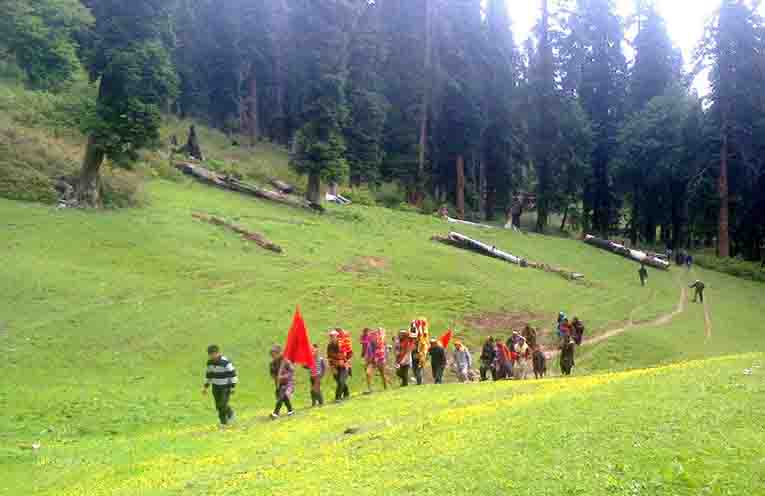
Among the most beautiful and spiritually significant destinations of Nagseni, Rakas Kund is a high-altitude lake surrounded by alpine meadows and forests. It forms an important annual pilgrimage destination, and the Rakas Kund Yatra attracts devotees and nature enthusiasts from across the district and beyond. The spectacular Himalayan scenery, rich alpine biodiversity, and the serenity of the lake make it one of the hidden gems of Kishtwar's pilgrimage landscape.
Bhattan Village — Buddhist Heritage
Historically identified as the ancient Vattaniya Ashram of Milindo-Panho, Bhattan village is the most historically significant settlement in the tehsil. The village and adjoining areas are believed to have been active centres of Buddhist intellectual and religious activity during ancient times. Its traditional architecture, scenic surroundings, and deep cultural heritage make it a compelling destination for visitors interested in both history and natural beauty.
Forest Trails & Nature Walks
Several parts of Nagseni offer superb nature walks, birdwatching, landscape photography, and exploration of untouched Himalayan ecosystems through dense deodar and pine forests. The serene environment and panoramic mountain views visible from higher elevations make the region ideal for eco-tourism, slow travel, and conservation-minded adventure enthusiasts.
Nag Devta Fairs & Local Festivals
Nagseni's living Naga-worship tradition gives rise to annual village fairs and religious gatherings at its sacred springs. These fairs — celebrated with deep community participation — offer visitors a rare window into a cultural tradition that links the prehistoric Naga cults of the Himalayan foothills with the daily life of the tehsil's people. Hindu and Muslim festivals are also celebrated together with great communal harmony.
️ Snow-clad Peaks & Scenic Viewpoints
From higher elevations within the tehsil, magnificent views of snow-clad Himalayan peaks are visible — including the ranges forming the southern boundary of the Paddar Valley. These viewpoints are ideal for mountain photography and sunrise/sunset experiences in conditions of extraordinary natural quiet and clean air.
Economy & Livelihood
The economy of Nagseni is primarily rural and rooted in its relationship with the land and forest. Agriculture and animal husbandry form the backbone of local livelihoods, supplemented by horticulture, collection of forest produce, and medicinal plant harvesting.
Key Economic Activities of Tehsil Nagseni
Agriculture
- Maize (primary crop)
- Wheat and paddy
- Seasonal vegetables
Horticulture
- Walnut (prized variety)
- Apple orchards
- Apricot cultivation
Livestock
- Sheep and goat rearing
- Cattle farming
- Seasonal transhumance
Forest Resources
- Timber from deodar & pine
- Medicinal herbs collection
- Fodder and forest produce
Culture, Traditions & Community Life
The people of Nagseni maintain a rich cultural heritage rooted in centuries-old traditions that blend Naga worship, Hindu festivals, and a spirit of communal harmony between the tehsil's Hindu and Muslim communities. Kishtwari, Kashmiri, and Urdu are spoken across the tehsil's villages.
Traditional mountain architecture, folk songs and dances, agricultural festivals, and the unique Naga-worship practices of the sacred springs define the cultural calendar and community identity of Nagseni. The people are widely known for their simplicity, hospitality, and their deep, respectful relationship with the natural world around them.
Village-wise Census Data — Tehsil Nagseni (2011)
The following table presents complete village-wise demographic data from the Census of India 2011 for the recorded villages of Tehsil Nagseni, covering population, sex ratio, literacy rates, and scheduled caste/tribe composition.
Connectivity & How to Reach
Why Visit Tehsil Nagseni?
Top Reasons to Explore Nagseni, Kishtwar
- Ancient Buddhist Heritage: Local tradition links the region to Nagasena — the 2nd century BCE philosopher of the celebrated Milinda Panha
- Gumai Nag Sacred Spring: One of the most revered natural springs in Kishtwar district, associated with ancient Naga-worship rituals
- Rakas Kund Pilgrimage: A beautiful high-altitude lake pilgrimage drawing devotees and trekkers from across the district
- Bhattan Village: Historically identified as the site of the ancient Vattaniya Ashram of Milindo-Panho
- Dense Himalayan Forests: Pristine deodar and pine forest ecosystems rich in medicinal herbs, birds, and mountain wildlife
- Living Naga Tradition: Witness a pre-Buddhist serpent-deity worship tradition still actively practiced in daily and ceremonial life
- Peaceful Eco-Tourism: One of the least commercialised tehsils in Kishtwar — ideal for slow travel, nature photography, and authentic village experiences
- Gateway position on the Kishtwar–Paddar Road — conveniently situated for visitors also heading to Tehsil Atholi (Sapphire Valley)
The Milinda Panha is considered one of the most important texts in the Theravada Buddhist canon, valued for its clear and accessible explanations of complex philosophical concepts — including the nature of the self, dependent origination, the nature of reality, and the path to enlightenment. The text has been translated into English three times — by Thomas William Rhys Davids in 1890, by Isaline Blew Horner in 1969, and most recently in 2025 by Maria Heim for the Murty Classical Library of India. Whether or not Kishtwar's Nagseni is the actual birthplace of Nagasena, its cultural claim to this great philosopher represents one of the most fascinating heritage stories in all of Jammu and Kashmir.
Related Tags
Related Topics on mykishtwar.com
 |
| Bhatan Nagseni Kishtwar |
 |
| Qomiye Naag Nagseni |
 |
| Nagseni Kishtwar |
 |
| Nagseni |
 |
| Nagseni |
